
Hip surgery
Tablets instead of injections after hip replacement?
Can clot prevention after a hip replacement be taken as a tablet? For some patients, yes. Oral options already have authorised uses after joint replacement. The important question is not simply which treatment is easier to take, but which is appropriate for the person and operation.
David Fernández-Fernández, MD4 min read
Clinical summary
Do not stop injections, add tablets or change anticoagulants yourself. Ask your surgical team whether an oral option fits your treatment plan.
01
What the new review found
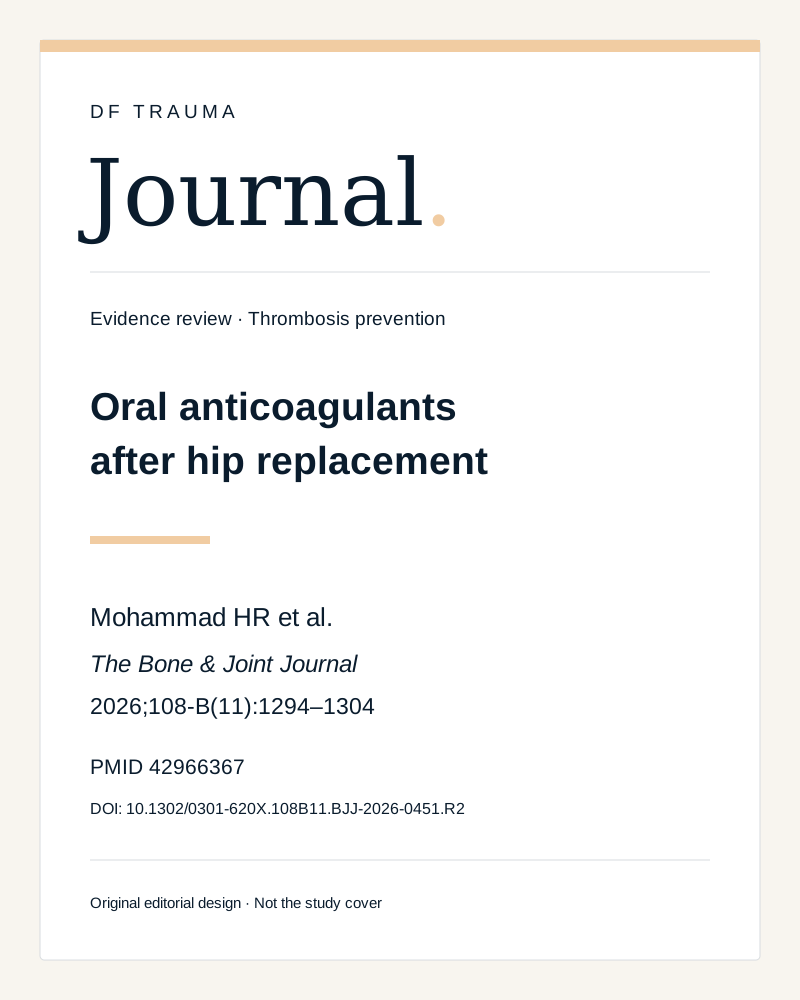
Mohammad and colleagues reviewed 22 randomised trials involving 28,112 elective hip-replacement patients. Compared with low-molecular-weight heparin, oral anticoagulants reduced venous thromboembolism (OR 0.62). Overall bleeding increased (OR 1.19); the UK-licensed-drug/dose subgroup showed no statistically significant difference (OR 1.06; 95% CI 0.95–1.18). Source: abstract, published 1 November 2026.
02
What those results do not establish
No significant difference does not prove equal safety. Odds ratios are not personal probabilities. This comparison is not evidence about aspirin or knee replacement.
Access note: this commentary uses the PubMed abstract, not the full article. We have not independently appraised trial-level bias, outcome definitions or supplementary analyses.
03
An oral option exists, but it is not a universal replacement
For example, apixaban has an EU-authorised indication for clot prevention after hip replacement. That does not make it suitable for everyone. Active bleeding, some liver conditions and other factors can make anticoagulants unsuitable. A tablet can still cause serious bleeding.
The UK licensing subgroup should not be read as a Spanish prescribing protocol. Drug choice, start date and duration must follow the locally applicable product information and the treating team’s assessment. This article gives no dosing or switching instructions.
04
A useful conversation before discharge
If injections worry you, say so before discharge. Ask whether an oral option is appropriate, how to follow the prescription, what to do after a missed dose and whom to contact if a problem occurs. A clear written plan matters more than a promise of “no injections”.
Tell the team about all medicines and supplements. Other treatments can alter anticoagulant effects; do not add over-the-counter medicines or stop prescribed treatment without advice.
05
The practical takeaway
The aim is informed choice, not replacing every injection with a pill. This educational article does not announce a new DF Trauma protocol or provide an individual prescription. Discuss any change with the clinician responsible for your care. Sources checked: 15 November 2026.
DF Trauma clinical perspective
The plan must fit the patient.
David Fernández-Fernández, MD, approaches hip reconstruction through diagnosis, patient-specific anatomy, surgical indication and recovery goals. Technology, implant choice and surgical approach are considered only where they add value to that complete clinical pathway.
The appropriate recommendation may be surgery, further assessment or continued non-operative care. No article can determine that choice without an individual medical evaluation.
Frequently asked questions
Questions patients ask
Bibliography
Bibliography and selected scientific reading
Clinical navigation
Hip replacementThrombosis preventionAnticoagulantsPatient information
Continue reading
Related DF Trauma Journal articles
Hip Surgery
Minimally invasive hip replacement: what patients should know before surgery
Read full article
Recovery
One week after total hip replacement: what early recovery can look like
Read full articlePrivate hip assessment
Request a specialist hip assessment
This article is for general educational purposes and does not replace individual medical assessment. Surgical indication, implant selection, approach and recovery planning must be evaluated case by case by a qualified medical specialist.